Submitted by webmaster on 20 August 2026

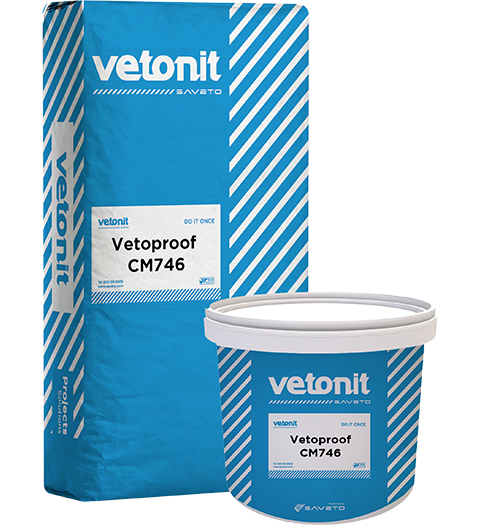
Vetoproof CM746

High performance, flexible, two-component, polymermodified cementitious waterproof coating.

Vetoproof CM746 is a two-component, polymer-modified cementitious waterproof coating consisting of a cementbased powder and a synthetic polymer liquid. It cures to form a seamless, flexible, and hard-wearing waterproof membrane with excellent adhesion to concrete and cementitious substrates. The coating delivers excellent crack accommodation and provides long-lasting protection against water ingress in wet areas and water-retaining structures.

Uses

  • Waterproofing of water tanks and reservoirs.
  • Swimming pools, fountains and water features.
  • Bathrooms, showers, kitchens and other wet areas.
  • Balconies, terraces and podium decks beneath tile finishes.
  • Basements, foundations and retaining walls.
  • Lift pits and elevator shafts.
  • Concrete and cementitious water-retaining structures.
  • Precast concrete elements.

Advantages

  • Excellent waterproofing performance against high positive and negative hydrostatic water pressure.
  • Crack bridging capabilities.
  • Excellent adhesion to concrete and cementitious substrates.
  • Breathable coating with high water vapor permeability.
  • Can be applied on damp substrates without the need for a primer (where applicable).
  • Easy to mix and apply by brush, roller or trowel.
  • Seamless, durable coating with long service life.

Usage Instructions

All surfaces should be dry and free from contamination, such as oil, grease, loose particles, decayed matter, moss algal growth, laitance, and all traces of mold release oils and curing compounds. This is best achieved by lightly gritblasting the surface. Where moss, algae, or similar growths have occurred, treatment with a proprietary biocide should be carried out after the grit-blasting process. Remove spalled and deeply disintegrated concrete to sound concrete and repaired with a Saveto repair system. 

If the surface contains small blow-holes, typically less than 1 mm wide, the coating can be applied directly onto the substrate without the need for treatment. 

Cracks that are less than 0.3 mm in width can be overcoated as long as the crack is not likely to open up to greater than 0.3 mm. Chased out cracks greater than 0.3 mm in width to 4 mm in width and approximately 15 mm in depth; fill with Vetoproof CM746. When the material in the crack hardens, apply the coating over the crack.

Pour Vetoproof CM746 liquid concentrate from the plastic container into a suitably sized mixing container. Commence mixing with a propeller agitator attached to a slow speed drill (300 - 500 rpm). Gradually, add the powder component to the liquid part to avoid lump formation and mix for 2 - 4 minutes. Immediately after mixing, use Vetoproof CM746. Do not mix material more than the quantity that can use within the pot life. You may keep the mixture to rest for not more than 3 minutes before the application.

Thoroughly dampen the substrate surface with water using a brush roller or spray bottle. High porosity substrates will require more dampening than dense substrates. Do not apply the coating when the substrate is wet but allow the water to soak until the substrate is just visibly damp before proceeding. Remove any excess water using a sponge. Stop any running water with a suitable plugging mortar such as Vetoproof CR747. Contact the local Saveto office for further advice on other suitable water-stopping materials.

Apply the first coat at a wet film thickness of 1 mm (approximate coverage per coat is 1.4 kg/m2). To ensure achieving the correct thickness, measure out an area (for example, 200 m2) then calculate how much material will be needed to cover this area. Monitor the coating thickness during application at regular intervals using a wet film gauge. During application, take care of filling the imperfections such as blowholes. If not, fill them while the coating is still in fluid status by using a dry sponge. If the coating dried before finding these imperfections, fill them using fresh material. The exact drying time will depend on surface temperature, relative humidity, and air movement. High temperatures and/or low humidity will reduce the drying time. This can vary from 1 to 16 hours. Leave the first coat to dry until firm and non-markable to the touch. There is no maximum time between coats; however, the surface may need cleaning with water before applying the second coat to remove potential contamination. 

Apply the second coat perpendicular to the first coat at a wet film thickness of 1 mm. Pre-dampening of the surface is not necessary before applying the second coat. 

However, Vetoproof CM746 is self-curing; it protects the freshly applied coating from rain and strong wind until it becomes firm to the touch. 

Where tiling is required, use a suitable cementitious tile adhesive after the membrane has fully cured. For water-retaining structures, perform a flood test only after the recommended curing period.

The most suitable brush is a soft-bristled wallpaper paste brush (120 - 220 mm wide). Where applied to larger areas, it is advisable to use a brush with a handle. Load the brush up well and spread the material to the required thickness. If the brush begins to drag during the application, do not add water to the material but dampen the surface again. Finish in one direction for a neat appearance. For floor application, a soft-bristled broom is recommended. Pour the material onto the substrate and then spread it to the required thickness.

Application by roller has the benefit of quick speeding over brush application, particularly on smooth substrates. A good quality medium hair roller is recommended. Load the roller well for ease of application. A heavy roller will leave a pattern; therefore, it is important to use a finishing tool to produce a smooth coating with a uniform 1 mm wet film thickness.

To produce a smooth finish or to repair film defects, use a finishing tool. Examples of suitable tools include a steel plastering trowel, a caulking tool, and a hard sponge. Use all those tools immediately after coating application; otherwise, the coating may drag or tear. When using a hard sponge, it should be dry or very slightly damp. Do not use a wet sponge, as this will cause the polymer to come to the coating surface, which will cause an unsightly white, streaky effect.

Follow the mixing procedure as previously described, taking extra care in mixing to ensure that no lumps remain in the mix. Place the mixing container on plastic sheeting to prevent contamination in the mix. Scrap the material from the mixing vessel above the wet line following every mix. Clean the mixing paddle to remove hardened material, which, if ingested, may cause blockage in the pump. 

Pour the material into the hopper. Scrape the sides of the hopper down at regular intervals to prevent hardened material from contaminating the mix. Place a cover over the hopper to prevent product skinning caused by water loss. 

Pump the mixed material through the hose to the spray gun. Adhere to the substrate preparation and coverage rates described above. Measure the wet film thickness using a wet film thickness gauge every 2 - 3 meters until the spray operator judges the ideal application speed and distance from the substrate. Re-spray any areas less than 1 mm thick. Subsequent film thickness measurements should be carried out approximately every 10m².

All movement and construction joints must be treated prior to application. Fill joints with a suitable elastomeric sealant and allow it to cure (For guidance on compatible sealants, contact your local Saveto representative). Apply a bond breaker (debonding tape) centrally over the sealant to prevent adhesion of the waterproofing system. 

Ensure that Vetoproof CM746 is not applied across (bridging) the joint, so that joint movement can be accommodated without cracking.

Allow the membrane to cure for at least 7 days before flood testing, water immersion, or permanent service. Curing times will be extended under low temperatures and high humidity. Allow the Vetoproof CM746 to cure for at least 28 days before commissioning.

Immediately following the application, clean all tools and equipment with clean water. Hardened material can be removed by mechanical means.

Explore More Products

Vetoproof EC761

Coal Tar Epoxy Solvent-Free Coating.

Vetoproof AM764

Pure Acrylic Waterproofing.

Vetoproof AM763

Acrylic Waterproofing.