تجاوز إلى المحتوى الرئيسي
Submitted by webmaster on 11 March 2026

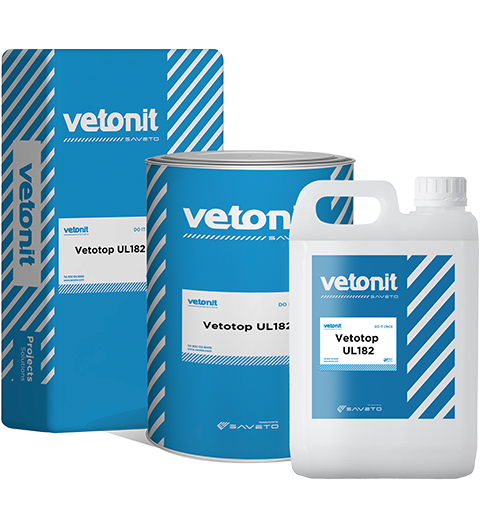
ڤيتوتوب يو ال 182

أرضية بولي يوريثان أسمنتية، مخصصة للاستخدامات شديدة التحمل، بسماكة 6-9 مم.

Vetotop UL182 is a heavy-duty, three-component, flow-applied polyurethane cement floor designed to provide a seamless, hygienic, and highly durable wearing surface for industrial environments. It combines excellent mechanical strength with outstanding resistance to abrasion, impact, and a wide range of chemicals. Vetotop UL182 is suitable for application onto concrete substrates in both new construction and refurbishment projects, delivering a dense, impermeable finish with low VOC emissions and long-term performance under demanding service conditions.

Uses

  • Heavy-duty polyurethane cement wearing surface for industrial flooring systems.
  • Designed for areas exposed to high mechanical, chemical, and thermal stress.
  • Ideal for wet and dry processing environments.
  • Food and beverage production areas and commercial kitchens.
  • Pharmaceutical, healthcare, and laboratory facilities.
  • Chemical plants and industrial processing units.
  • Manufacturing workshops, warehouses, and logistics zones.

Advantages

  • High mechanical strength with excellent resistance to abrasion and impact.
  • Outstanding resistance to a wide range of chemicals and cleaning agents.
  • Seamless, dense, and impermeable surface finish.
  • Bacterial and mould growth resistant.
  • Hygienic and easy to clean.
  • Slip-resistant.
  • Low VOC emissions.
  • Very minimal odor during application.
  • Thermal expansion characteristics similar to concrete.
  • Tolerant to residual substrate moisture.
  • Fast curing system suitable for rapid return to service.

Usage Instructions

All substrates must be structurally sound, clean, and suitably prepared prior to application. The concrete substrate shall have a minimum compressive strength of 25 – 30 MPa and a minimum pull-off tensile bond strength of 1.5 MPa. The surface must be free from laitance, weak or friable layers, and any surface defects that may compromise the integrity of the flooring system. Mechanical surface preparation by shot blasting, captive blasting, or diamond grinding is required to achieve a clean, open-textured surface profile suitable for bonding. Acid etching is not permitted. The prepared surface should provide a uniform mechanical key to ensure proper adhesion. 

Vetotop UL182 may be applied to green or damp concrete provided there is no standing water and a functioning damp proof membrane (DPM) from the Vetotop product range is incorporated within the structure where required. The substrate may be in a surface dry or saturated surface dry (SSD) condition, but free water must not be present at the time of application. Where excessive moisture is detected or no effective DPM exists, appropriate remedial measures must be implemented prior to installation.

All construction joints, expansion joints, and cracks must be properly assessed and treated before application. Static cracks shall be repaired using suitable epoxy repair mortar from the Vetorep product range. Dynamic cracks must be treated as movement joints and appropriately detailed. All movement joints in the substrate must be sealed with a suitable elastic joint sealant from the Vetoflex sealant range. 

Incorrect treatment of cracks and joints may result in reflective cracking and reduced service life. 

The substrate temperature during application must be between +8°C and +30°C, and at least 3°C above the dew point to prevent condensation. Proper environmental control is essential to avoid bond failure, blistering, or surface defects.

Priming shall be carried out by applying a thin scratch coat of Vetotop UL182 at a thickness of 1mm onto the prepared substrate. The mixed resin components shall be thoroughly blended and applied using a steel trowel, firmly worked into the surface to ensure full wetting of the substrate and sealing of residual porosity. Particular attention shall be given to highly absorbent areas to achieve complete substrate sealing. The main body coat of Vetotop UL182 shall be applied within the recommended recoat window to ensure proper interlayer bonding. If the scratch coat has cured beyond the recoat time, light abrasion and cleaning will be required prior to overapplication.

Vetotop UL182 is supplied as a three-component system comprising Part A (resin), Part B (hardener), and Part C (graded aggregate). The components are pre-weighed and must be mixed in full units. Partial mixing is not permitted. 

Prior to mixing, all components should be conditioned to an ambient temperature between +15°C and +25°C. Part A shall be briefly pre-stirred to ensure uniformity. Part B shall then be added in full to Part A and mechanically mixed using a slow-speed electric mixer (300-400 rpm) for approximately 1-2 minutes until a homogeneous blend is achieved. The combined resin mixture (Parts A + B) shall then be transferred into a suitable forced-action mixer. While mixing, Part C shall be gradually added in full and mixed continuously for a minimum of 2-3 minutes until a uniform, lump-free and consistent material is obtained. Proper mixing is essential to ensure full wetting of aggregates and consistent mechanical performance. Care shall be taken to scrape the sides and bottom of the mixing vessel to ensure complete incorporation of all materials. Over-mixing or high-speed mixing must be avoided as this may introduce excessive air into the system. 

The mixed material must be applied immediately after mixing and within the specified pot life. Do not add water, solvent, or any other materials to the mix. Mixing outside the recommended temperature range may significantly affect workability and curing characteristics.

mmediately after mixing, the material shall be discharged onto the primed substrate and spread evenly to the specified thickness using a steel trowel or gauge rake. The material must be placed continuously to maintain a wet edge and avoid cold joints. The recommended nominal thickness for heavy-duty applications is 6 – 9 mm, depending on project specifications and service conditions. 

After placing, the surface shall be compacted and closed using a steel trowel to achieve a uniform, dense finish. Where a slip-resistant profile is required, the surface texture may be adjusted during finishing to achieve the desired slip classification. Care shall be taken to ensure consistent thickness across the application area. Expansion joints, construction joints, and terminations must be properly detailed and respected during installation. 

For large areas, work should be planned in sections to ensure continuity and uniform appearance. The installed system must be protected from moisture, contamination, and mechanical damage during the curing period.

Curing time is dependent on ambient and substrate temperatures. At approximately +8°C, the surface is typically serviceable after 16 – 24 hours and achieves full chemical and mechanical resistance after 7 days. Lower temperatures will extend curing times, while higher temperatures will accelerate curing and reduce working time. 

The installed system must be protected from thermal shock and aggressive chemical exposure until full cure has been achieved. Proper ventilation shall be maintained during curing to ensure consistent performance.

All tools and application equipment should be cleaned immediately after use with Vetonit Solvent XX400. Hardened or cured material can only be removed by mechanical means.

Explore More Products

ڤيتوتوب يو سي 363

غشاء عزل مائي بولي يوريثان لأرضيات المرور

ڤيتوتوب اي سي 498

طلاء إيبوكسي خالٍ من المذيبات.

كويك فلور فيكس

مونة إصلاح إسمنتية سريعة التصلب.