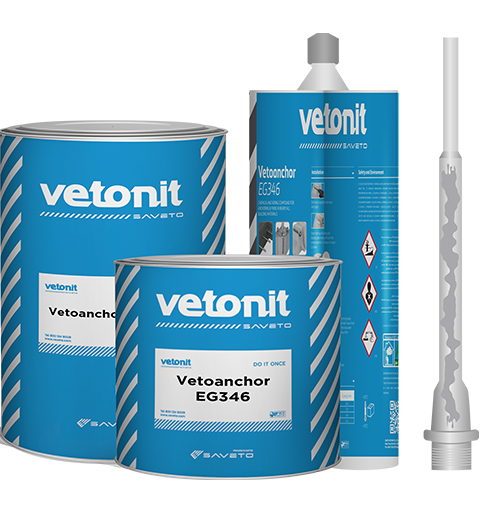
Vetoanchor EG346
High strength, solvent-free, two-component, non-shrink epoxy adhesive anchoring grout for structural & underwater applications.
Vetoanchor EG346 is a high-strength, solvent-free, two-component epoxy adhesive anchoring grout formulated to provide excellent mechanical strength, superior adhesion to concrete and steel, and non-shrink performance. The product is available in two packaging systems: a twin cartridge system, designed for controlled dispensing and precision anchoring applications, and a pre-measured resin and hardener kit, available in Pouring Grade (PG) and Gun Grade (GG) for a wide range of structural grouting, anchoring and repair applications.
Its versatile formulation is suitable for anchoring bolts, dowels and reinforcement bars, grouting beneath machine base plates and structural steelwork, bonding concrete and steel elements, and filling cracks, cavities and rigid joints. Vetoanchor EG346 is also suitable for underwater applications when installed by appropriately trained personnel.
Uses
- Anchoring steel reinforcement bars, bolts and dowels into concrete, including underwater applications.
- Grouting beneath machine base plates, structural steelwork and equipment supports.
- Bonding steel to concrete and concrete to concrete.
- Filling cracks, cavities, voids and rigid joints in concrete elements.
- Filling joints between acid-resistant tiles.
Advantages
- Non-shrink; ensures effective load transfer.
- High compressive, flexural and bond strength.
- Excellent adhesion to concrete and steel.
- Resistant to impact, vibration and dynamic loading.
- Protects embedded steel components by preventing water ingress around the anchorage.
- Good resistance to a wide range of chemicals and fuels.
- Resistant to fungal and bacterial growth.
- Durable and long-lasting.
Usage Instructions
All surfaces must be structurally sound, clean and free from dust, laitance, loose particles, oil, grease, curing compounds, coatings and other contaminants that may impair adhesion. Concrete surfaces should be mechanically prepared by grinding, grit blasting or another suitable method to expose a clean, sound substrate. Steel surfaces must be free from rust, mill scale, oil and grease and should preferably be abrasiveblasted to bright metal. Remove all dust and debris using clean, oil-free compressed air or an industrial vacuum.
Preparation of Anchoring Holes
Drill holes to the diameter and depth specified in the approved design. Ensure that the hole surfaces are sufficiently rough to provide adequate mechanical keying. Diamond-cored holes must be suitably roughened, while cast holes should preferably have an inverse dovetail configuration.
Thoroughly clean each hole using an appropriately sized steel or nylon brush and clean, oil-free compressed air. Repeat the brushing and blowing procedure until all drilling dust, loose particles and debris have been removed.
For twin cartridge applications, concrete must be dry, with a relative humidity below 75%. For other applications, remove standing water wherever practicable.
Two-Component Can System (Pouring Grade & Gun Grade)
Vetoanchor EG346 is supplied as pre-measured resin and hardener components. Mix the resin component separately before adding the complete contents of the hardener. Mix using a slow-speed electric drill fitted with a suitable paddle until a uniform, streak-free consistency and colour are achieved. Scrape the sides and bottom of the container during mixing to ensure complete incorporation of both components.
Mix complete packs only and maintain the stated mixing ratio. Do not add water, solvent or any other material. Prepare only the quantity that can be applied within the product’s working time.
Twin Cartridge System
Remove the cartridge cap and red stopper, then securely attach the appropriate static mixing nozzle. Insert the cartridge into a compatible dispensing gun, ensuring that the cartridge and nozzle are correctly assembled. Dispense the initial material to waste, approximately 2 – 3 trigger pulls or 10 mL, until a consistent, uniform grey colour without streaks is achieved. Discard the initial discharge into suitable waste packaging. The static mixing nozzle automatically combines both components during dispensing. Ensure that the nozzle contains its internal spiral mixing element and do not modify, cut or shorten the nozzle.
If the material begins to gel inside the nozzle or dispensing is interrupted beyond its working time, replace the static mixer before resuming application.
Anchoring Bolts, Dowels & Reinforcement Bars
For the two-component can system in Pouring Grade (PG), partially fill the prepared anchoring hole with freshly mixed grout, starting from the bottom wherever possible.
For Gun Grade (GG), transfer the mixed material into suitable heavy-duty dispensing equipment and inject from the back or bottom of the hole while gradually withdrawing the nozzle.
For the twin cartridge system, insert the static mixing nozzle to the bottom of the prepared hole and dispense the resin while gradually withdrawing the nozzle, ensuring continuous filling without air entrapment.
Following placement of the material, insert the clean, oil-free bolt, dowel, stud or reinforcement bar using a slow twisting motion until the specified embedment depth is achieved. Ensure complete encapsulation of the embedded element and remove excess material from the surface.
Maintain the correct alignment and leave the anchor undisturbed until the material has sufficiently hardened. Do not apply loads before the specified curing period.
Grouting Beneath Base Plates & Structural Steelwork
Use the two-component can system in Pouring Grade (PG) for grouting beneath machine base plates, structural steelwork and equipment supports.
Ensure that the base plate is securely fixed and correctly aligned before grouting. Provide rigid, sealed and leak-free formwork with a suitable pouring head and adequate venting points.
Immediately after mixing, pour Vetoanchor EG346 continuously from one side only, maintaining sufficient head pressure to achieve complete filling beneath the plate while allowing entrapped air to escape.
Avoid pouring from multiple sides or vibrating the grout, as this may introduce air or cause segregation. Light rodding or gentle tapping of the formwork may be used where necessary to assist material flow.
Filling Cracks, Cavities & Rigid Joints
Open and clean the repair area to remove weak, loose or contaminated material. Use the two-component can system in Pouring Grade (PG) for horizontal cracks, cavities and confined voids where free-flowing material is required. For vertical, overhead or localized repairs requiring greater material retention, use the Gun Grade (GG).
Place or inject the material firmly into the prepared area, ensuring complete contact with the sides and base of the repair. Finish exposed surfaces using a suitable steel trowel.